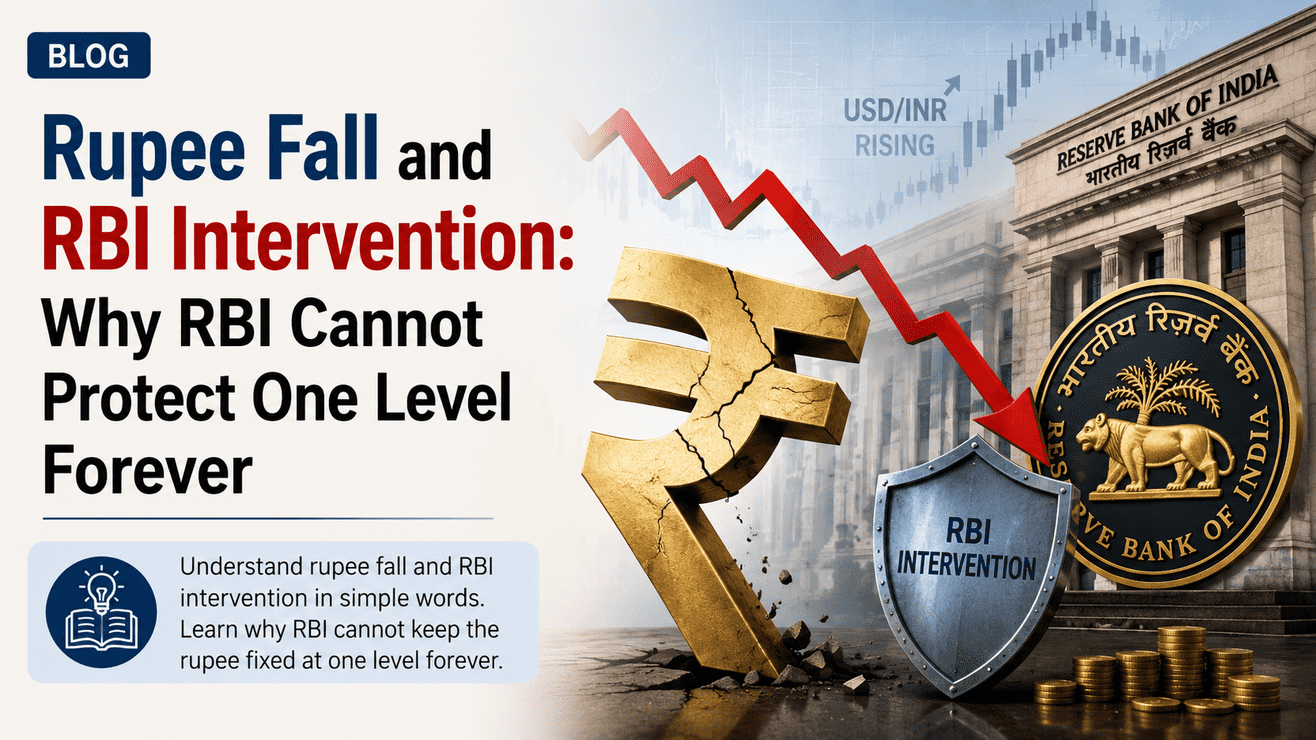
Indian rupee fall and RBI Intervention: Why RBI Cannot Protect Indian rupee at One Level Forever
Rupee fall and RBI intervention are again being discussed after the rupee touched a low of 96.96 against the U.S. dollar. Later, it recovered near 95.23, helped by lower crude oil prices and likely support from the Reserve Bank of India through state-run banks.
Many investors are asking one simple question:
If RBI has dollar reserves, why does it not simply sell dollars and stop the rupee from falling?
The simple answer is:
RBI can slow down a sharp fall.
But it cannot keep the rupee fixed at one number forever.
Why RBI Cannot Just Defend One Number
Think of the rupee like a car on a road.
If the road is rough, the driver can slow down.
If there is a sharp turn, the driver can control the speed.
But the driver cannot change the entire road.
RBI is like that driver.
It can manage sudden shocks.
It can reduce panic.
It can use dollar reserves when needed.
But the rupee moves because of many things:
- crude oil prices
- strength of the U.S. dollar
- foreign investors entering or leaving India
- inflation
- imports and exports
- global uncertainty
So, the RBI’s job is not to stop the rupee from moving.
Its job is to make sure the movement does not become disorderly.
Why Selling Dollars Has a Cost
When RBI sells dollars, it gets rupees back.
This may support the rupee for some time. But it also removes rupees from the banking system.
If too many rupees are removed, money can become tight. Loans may become costlier. Businesses may find borrowing harder. Growth may get affected.
Also, foreign exchange reserves are like a family’s emergency fund.
You use them when needed.
You do not spend them all at once.
India’s foreign exchange reserves were around $688.89 billion for the week ended May 15, after falling by $8.09 billion, according to RBI data reported by The Economic Times.
So, RBI uses reserves carefully.
What Investors Should Do
- Do not panic because of one rupee level
A weaker rupee does not automatically mean crisis. - Look at your portfolio
Export-oriented companies may benefit from a weaker rupee. Import-heavy companies may face pressure. - Be careful with foreign spending
Education, healthcare and business needs are important. But unnecessary dollar spending should be reviewed. - Do not keep money idle out of fear
If money is sitting in liquid or arbitrage funds only because you are afraid, review whether that money has a clear purpose. - Invest gradually
Use SIPs, STPs, phased investments or a written re-entry plan instead of waiting for perfect stability.RBI’s job is not to protect one exact rupee level.
Its job is to maintain stability without hurting growth.
Investors should follow the same principle.
Do not panic over one number.
Do not freeze money out of fear.
Do not make sudden decisions because of currency movement.Give every rupee a role: safety, liquidity, growth or long-term goals.
A D Naik Wealth Pvt. Ltd. | AMFI Registered Mutual Fund Distributor | ARN: 73268
Mutual Fund investments are subject to market risks. Read all scheme-related documents carefully. This article is for educational purposes only and should not be treated as investment advice or a recommendation.