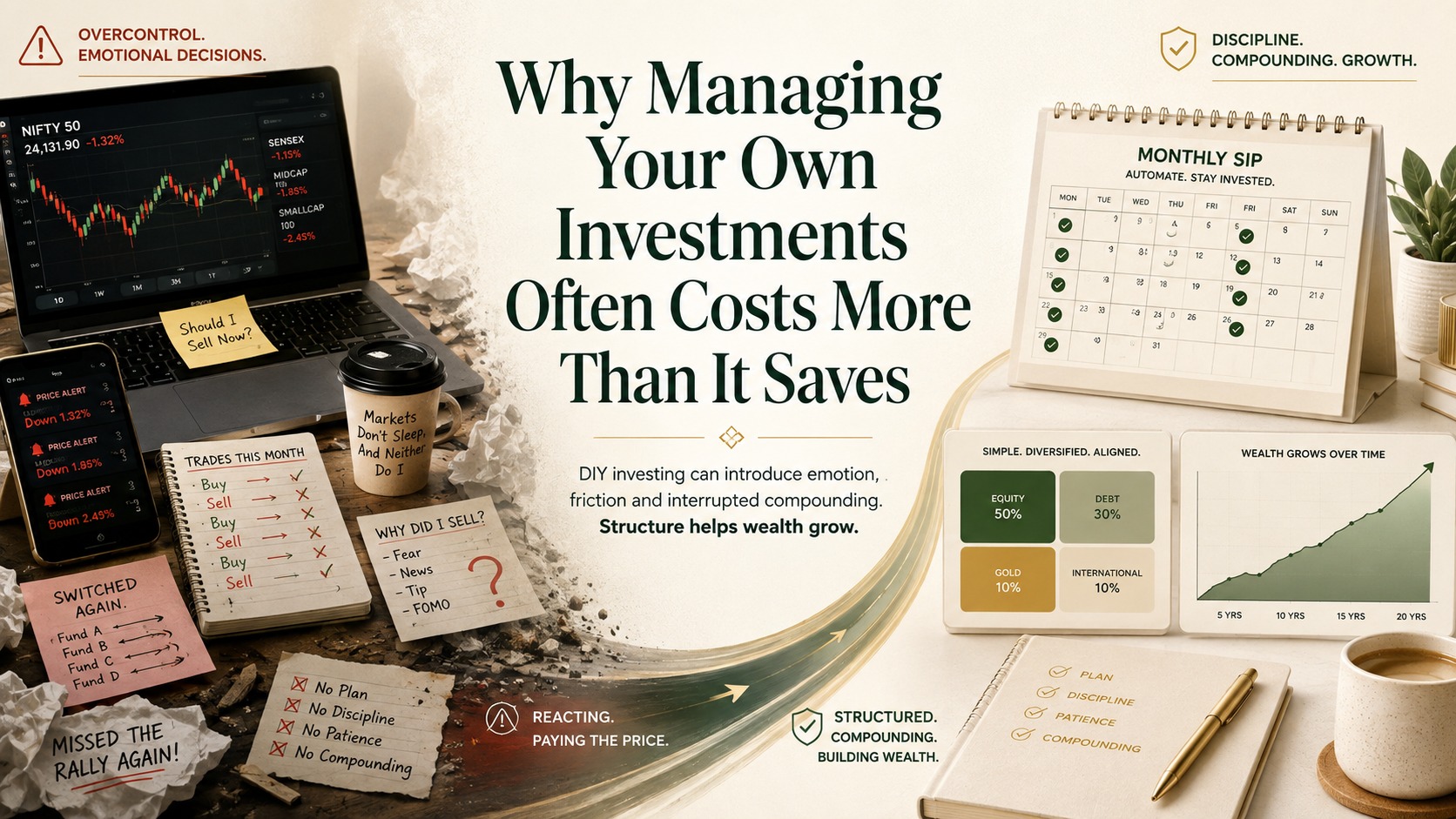
Why Managing Your Own Investments Often Costs More Than It Saves
There is a pattern that emerges among many intelligent, high-earning professionals once their income reaches a certain level. Having mastered their careers through competence and discipline, they apply the same instinct to their personal finances—deciding to manage their investments themselves.
The reasoning is understandable. If you have risen to a senior position through your own expertise, it is natural to feel that financial management is a skill you can acquire the same way. In practice, however, the qualities that drive professional success—decisiveness, active problem-solving, a bias toward action—frequently work against you in an investment context.
The financial markets do not reward effort in the way a career does. They reward patience, consistency, and the discipline to do less—often precisely when the instinct is to act.
The Professional Competence Trap
Consider how you approach your professional work. If you are an engineer, you can isolate a problem, apply logic, and arrive at a solution. If you are a doctor, you can interpret a symptom and prescribe a treatment. In both cases, your direct actions produce predictable results. You are, in the most literal sense, in control.
Financial markets operate entirely differently. They are not a system that responds predictably to logic or effort. They are shaped by the collective psychology of millions of participants, reacting simultaneously to economic data, geopolitical events, and one another’s behaviour. No individual—regardless of their intelligence or professional credentials—can reliably predict or control those outcomes.
The trap lies in the assumption that professional competence in one domain transfers automatically to another. It does not. And the consequences of acting as though it does can be significant.
Three Ways DIY Investing Tends to Backfire
When professionals manage their own investments without a structured system, three behavioural patterns tend to emerge:
1. The Impulse to Act
Because it is your own money, and because you are accustomed to adding value through active intervention, there is a persistent urge to do something. This manifests as switching mutual funds after a difficult quarter, reallocating capital toward whichever sector is currently performing, or reacting to news headlines that have already been priced into the market. Each of these actions feels like portfolio management. In aggregate, they introduce friction, cost, and underperformance.
2. Emotional Decision-Making During Downturns
It is straightforward to hold a position when markets are rising steadily. The real test comes during a sharp correction. When a portfolio falls 15% in a matter of weeks, the instinct for self-preservation can override long-term strategy entirely. Without an objective framework or an experienced adviser to provide perspective, many DIY investors liquidate positions at exactly the moment when staying invested is most important. The result is not just a missed recovery—it is a permanent loss that compounding can never fully repair.
3. Mistaking Income for Financial Security
A high salary creates a sense of resilience that may not reflect the underlying financial reality. Many self-directed investors carry insufficient emergency reserves and inadequate insurance on the assumption that their income will protect them from any crisis. When an unexpected event—illness, redundancy, or a market shock—disrupts that income, the absence of a proper safety net forces precisely the kind of distressed asset liquidation that is most damaging to long-term wealth.
A Structured Approach: Building the System That Works Without You
The most effective long-term investors are not those who are most actively involved in managing their portfolios. They are those who have built a structure that operates reliably, independently of their mood, the news cycle, or the market’s short-term direction. The diagram below contrasts these two approaches.
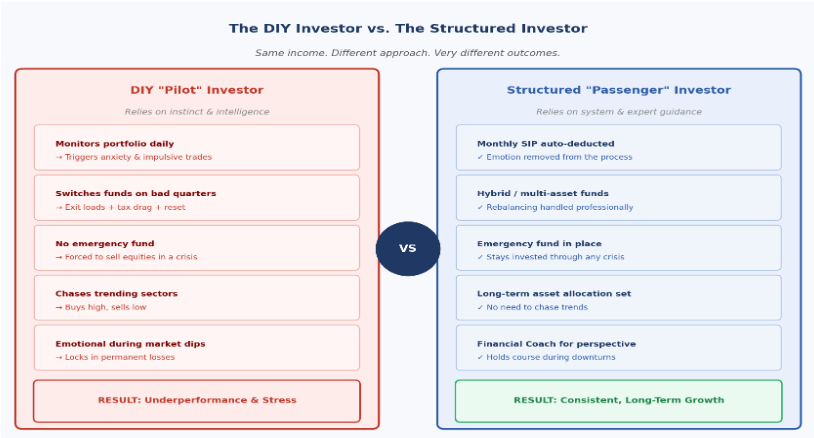
The figures used above are purely illustrative and do not indicate or guarantee future returns.
Automate Your Contributions
A Systematic Investment Plan (SIP) deploys your money into your portfolio automatically on a fixed date each month, before it is available for discretionary spending. This removes the need to make a conscious investment decision every month—and with it, the risk that any given month’s emotions or circumstances interrupt your compounding.
Let the Portfolio Rebalance Itself
Rather than manually shifting allocations in response to market conditions, consider investment vehicles that manage diversification internally. These multi-asset structures blend growth-oriented and stable holdings within a single framework. management teams automatically rebalance these components based on market movements—eliminating friction costs, regulatory events, and the need for ongoing manual intervention.
Establish Your Safety Net Before Increasing Exposure
Before directing surplus income into higher-risk investments, ensure you have a dedicated emergency fund covering three to six months of living expenses, held in a liquid instrument. This reserve is not idle capital—it is what allows your investment portfolio to remain untouched when life does not go to the roadmap. Adequate health and income protection insurance serves the same purpose: ensuring that a personal setback never becomes a financial one.
The Cost of Being Your Own Pilot
The chart below illustrates the long-term financial difference between these two approaches, using a monthly SIP of ₹20,000 over 20 years.
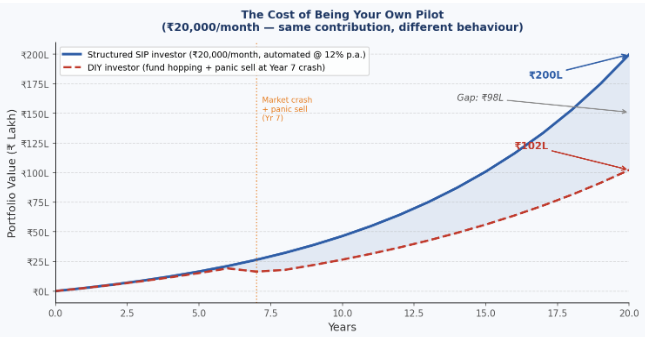
The figures used above are purely illustrative and do not indicate or guarantee future returns.
Both investors contribute the same ₹20,000 per month. The structured investor automates their SIP and stays fully invested. The DIY investor switches funds periodically, incurring exit loads and tax drag, and panic-sells 30% of the portfolio at the Year 7 market low. By Year 20, the gap exceeds ₹98 lakh—not because of better stock selection, but because of one structural difference: removing emotion from the process.
The Most Effective Financial Decision You Can Make
The professionals who build the most durable financial positions are rarely those who are most actively engaged in managing them. They are those who have invested the time upfront to build a sound structure—and then had the discipline to let it run.
You do not need to become an expert in equity analysis or macroeconomics. You need a clear investment raodmap, the right instruments to execute it, a safety net that protects it, and the guidance to stay committed to it when conditions are difficult.
If you would like help designing that structure around your specific circumstances, speak with a Financial Guide today.