
The Hidden Cost of Wealth Mirroring

In an age of constant digital visibility, it has never been easier to observe how others appear to live. When colleagues, peers, or social media contacts showcase premium lifestyles—luxury vehicles, high-end properties, frequent travel—a subtle but powerful psychological mechanism can take hold.
This is Wealth Mirroring: the tendency to replicate the consumption patterns of those around us, under the assumption that visible spending reflects genuine financial strength. For salaried professionals and mid-career earners in particular, this pattern can quietly erode years of earning potential—without ever feeling like a mistake in the moment.
A good MFD does not just help you invest—they help you recognise and resist the behavioural patterns that prevent wealth from being built in the first place.
Confusing Income with Wealth
Many professionals operate under the implicit belief that a high salary, a senior title, or a prestigious qualification automatically produces financial security. This misconception is at the heart of wealth mirroring, and it tends to follow a predictable and damaging sequence:
- The Exposure: An individual observes a peer financing a luxury car, upgrading their home, or spending freely on premium experiences.
- The Emulation: Driven by the desire to project a similar standard of living, they use debt, leverage, or a significant portion of their income to replicate that lifestyle.
- The Fracture: Because the spending rests on high fixed outgoings rather than growing assets, any income disruption, interest rate rise, or economic correction can cause the entire structure to collapse rapidly.
Even highly educated, high-earning professionals are not immune. When emotion drives financial decisions, the consequences can be severe—regardless of income level.
Three Ways Wealth Mirroring Undermines Your Financial Future
1. Lifestyle Inflation Crowds Out Investment Capital
Every rupee directed toward a depreciating lifestyle asset—a financed vehicle, a premium subscription, or a status-driven purchase—is a rupee not compounding in your portfolio. Wealth is not found in what others can see; it is built quietly through assets that grow while you go about your life. When ego shapes your monthly budget, lifestyle inflation becomes a direct and ongoing cost to your long-term financial security.
2. Interrupted Compounding Is Wealth Left Behind
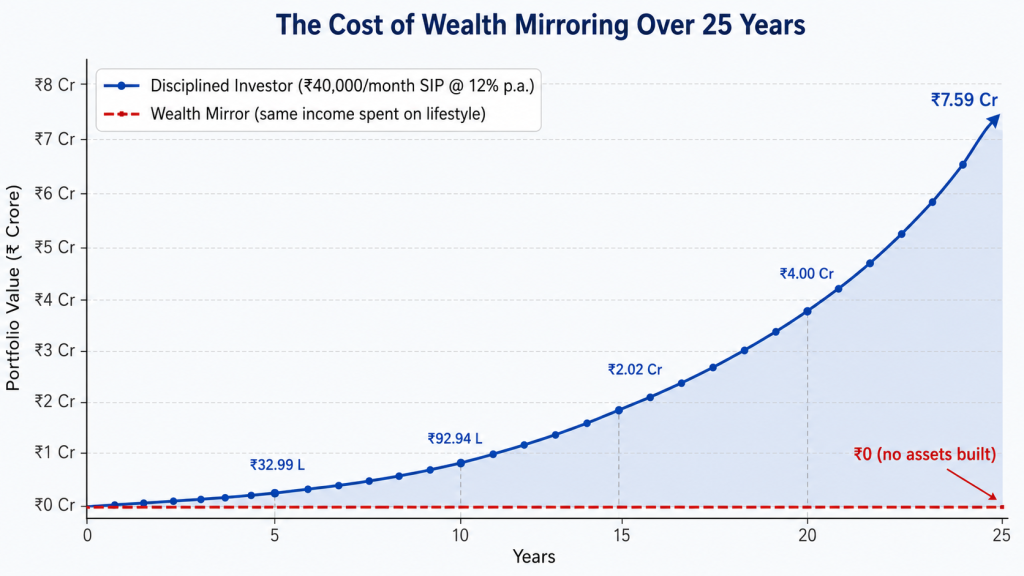
The chart below illustrates the long-term difference between investing ₹40,000 per month consistently through a Systematic Investment Plan (SIP) and spending the same amount on lifestyle maintenance.
The figures used above are purely illustrative and do not indicate or guarantee future returns.
The difference is not created by extraordinary investment skill. It is created by time, consistency and the power of compounding. A monthly SIP of ₹40,000, invested for 25 years at an assumed annualised return of 12%, could grow to approximately ₹7.59 crore.
During this period, the total amount invested would be ₹1.20 crore, while the remaining value would represent the potential growth generated through long-term compounding. In contrast, spending the same ₹40,000 every month on lifestyle maintenance or status-driven purchases creates no investment asset and produces nothing that compounds.
When surplus income is repeatedly redirected towards lifestyle expenses instead of long-term investment, the compounding clock is effectively paused. The early years lost to delayed investing are difficult to recover because compounding benefits most from time.
Starting early, investing consistently and avoiding unnecessary lifestyle inflation can provide working professionals with a significant advantage in building long-term wealth.
Illustration assumption: Monthly SIP of ₹40,000 for 25 years at an assumed annualised return of 12%. Actual mutual fund returns are market-linked and may vary.
3. High Overheads Create Vulnerability
Individuals who mirror the lifestyles of others often carry substantial fixed monthly costs—loan repayments, lease commitments, maintenance expenses—with little in the way of liquid reserves. When markets fall or income is disrupted, these obligations do not reduce. Without a financial buffer, a leveraged lifestyle can unravel quickly, forcing asset liquidations at the worst possible time.
Building Wealth on Your Own Terms
Breaking the cycle of wealth mirroring does not require dramatic sacrifice. It requires a shift in what you measure and what you prioritise.
Automate Your Investment Before You Can Spend It
Willpower alone is an unreliable defence against social pressure and lifestyle creep. A more effective approach is to remove the decision entirely. By establishing an automatic monthly Systematic Investment Plan (SIP), your money is deployed into your portfolio before it is available to spend. Consistency is built into the system rather than dependent on your mood or the month’s circumstances.
Use Professionally Managed Funds
You do not need to monitor markets or make complex asset allocation decisions yourself. Funds are managed by professional teams whose sole focus is portfolio performance and risk management. This keeps emotion out of the investment process and ensures your capital remains strategically allocated, even when market conditions are uncertain.
Redefine What Financial Success Looks Like
True financial security is not visible from the outside. It is the freedom to make choices without financial constraint—the ability to change careers, support your family, retire on your own terms, or weather an unexpected setback without lasting damage. When you measure success by the growth of your portfolio rather than the impression you create, you build something that actually belongs to you.
Recognising wealth mirroring in yourself is the first step. Consistently acting against it—especially when peers are spending freely and social pressure is high—is considerably harder.
An MFD provides more than suggestions. They help you:
- Identify where lifestyle inflation is quietly reducing your investable surplus
- Build a spending and investment structure designed around your actual goals, not a comparison with others
- Maintain discipline during periods when the temptation to spend is highest
- Review and strengthen your financial roadmap as your income, responsibilities, and aspirations evolve
The right guidance does not just improve your investment returns—it changes the financial behaviours that determine whether wealth is built at all.
The Measure That Matters
Lasting wealth is not built by those who appear the most successful. It is built by those who consistently prioritise compounding over perception, and long-term security over short-term status.
The professional who quietly invests ₹50,000 every month for twenty-five years will, in most scenarios, finish significantly ahead of the colleague who spent the same amount projecting a lifestyle they could not fully afford.
If you would like to build a financial roadmap that reflects your real goals rather than someone else’s appearance, speak with a MFD today.
DISCLAIMER: Mutual Fund investments are subject to market risks. Read all scheme related documents carefully.