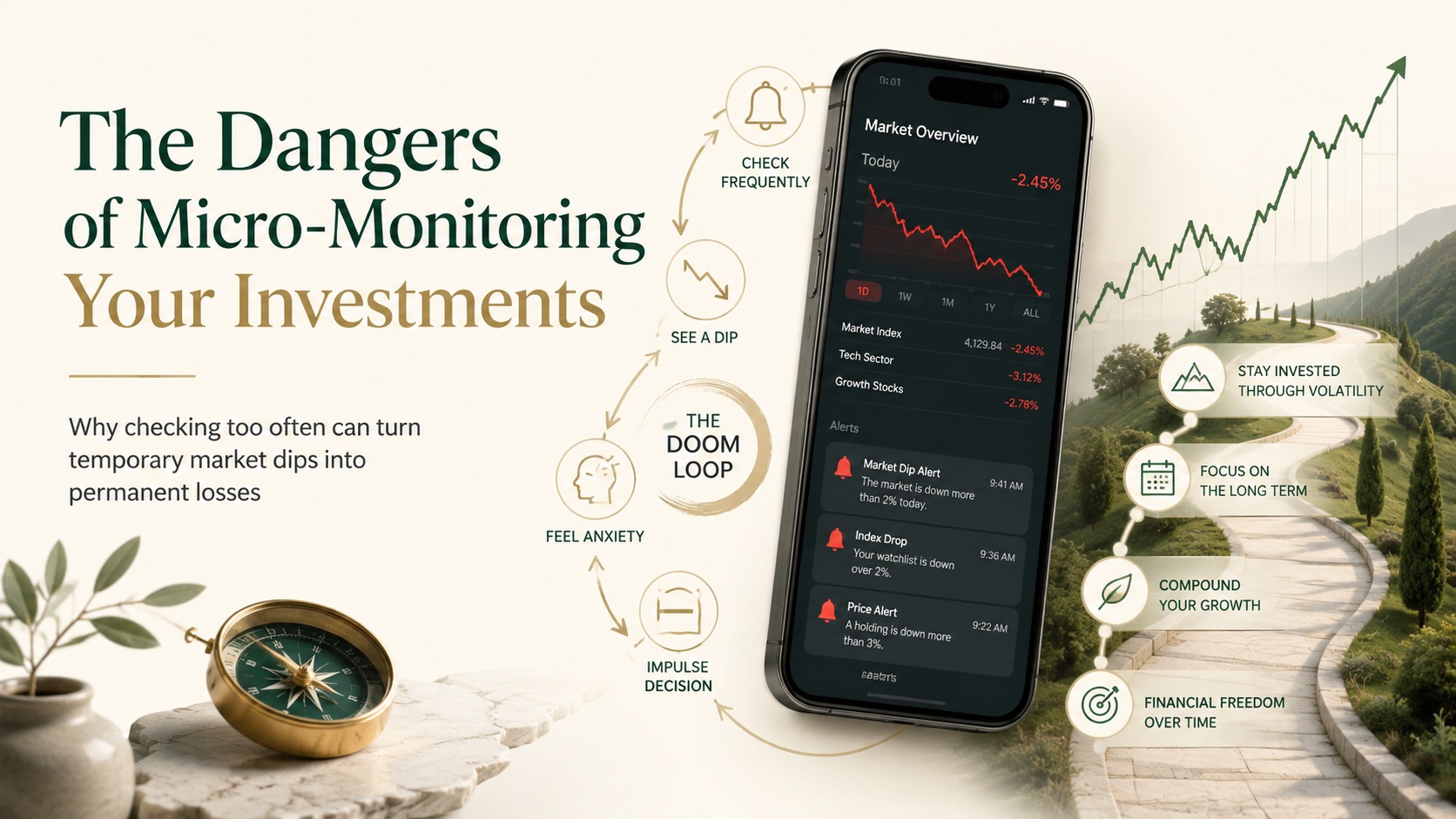
The Dangers of Micro-Monitoring Your Investments
There is a particular kind of investor anxiety that did not exist thirty years ago. In an earlier era, a retail investor might receive a quarterly statement in the post, review it over a weekend, and carry on. The gap between observation and reaction was built into the process.
Today, the entire value of a portfolio is visible in real time, on a device that most people check dozens of times a day. Markets move continuously. Financial news is published without pause. Portfolio apps send notifications when values shift. The practical result is that many investors are now exposed to every fluctuation in their holdings—and because we are wired to respond to perceived threats, that exposure consistently produces poor decisions.
This is micro-monitoring: the habit of checking your investments with a frequency that bears no relationship to your investment horizon, and which makes short-term market noise feel like a signal that demands a response. It is one of the most common and least discussed causes of investment underperformance.
The Mismatch Between Checking Frequency and Investment Horizon
Most long-term investors—those building toward retirement, financial independence, or a specific goal ten to twenty years away—hold broadly diversified portfolios through mutual funds or SIPs. The design of these instruments is explicitly long-term. They are constructed to grow through multiple market cycles, absorbing short-term volatility and delivering returns that are meaningful over years and decades.
Daily portfolio checks introduce a profound mismatch. A portfolio designed to be evaluated over a decade is being assessed over 24-hour windows. What registers as a “loss” on a Monday morning is, in almost every case, a temporary fluctuation in the market’s collective mood—not evidence that the underlying investment strategy has failed.
The investor who checks daily and the investor who checks quarterly hold identical positions. But their experience of those positions—and critically, their likelihood of acting on what they see—is entirely different.
What You Actually See Depends on How Often You Look
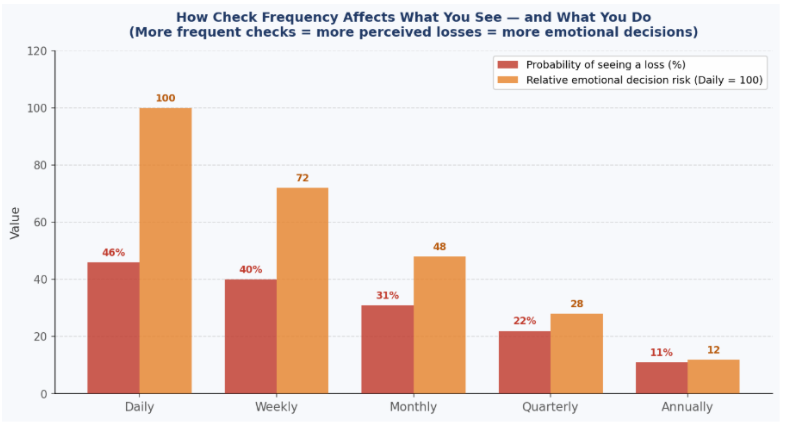
Research into equity market data over long periods reveals a counterintuitive truth: the more frequently you check your portfolio, the more often you will encounter a negative reading—even in a portfolio that is performing well over time.
The figures used above are purely illustrative and do not indicate or guarantee future returns.
An investor who checks their portfolio daily will encounter a negative day roughly 46% of the time—almost every other session. The same investor checking quarterly will see a loss approximately 22% of the time. Checking annually reduces that figure further still, to around 11%. The portfolio has not changed. The market has not changed. Only the observation frequency has—and with it, the investor’s entire perception of how their investment is performing.
Because human beings are hardwired to weight losses more heavily than equivalent gains—a well-documented phenomenon known as loss aversion—frequent exposure to negative readings creates disproportionate anxiety. That anxiety, in turn, creates pressure to act. And acting on short-term fluctuations in a long-term portfolio is one of the most reliable ways to reduce its eventual value.
The Micro-Monitoring Doom Loop
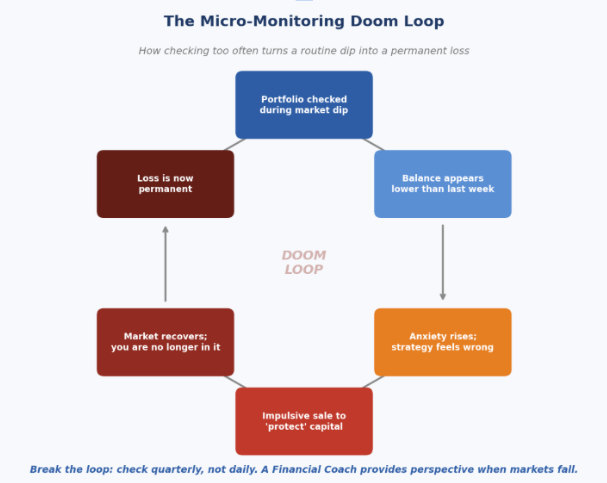
Micro-monitoring does not just create anxiety in isolation. It tends to set off a self-reinforcing cycle that escalates from a routine market movement to a permanent financial loss.
The figures used above are purely illustrative and do not indicate or guarantee future returns.
The loop begins with a portfolio check during a routine market dip. The lower balance triggers anxiety. The investor begins to question their strategy. Without an objective framework or external perspective, that uncertainty resolves into action—a sale, a reallocation, a pause in SIP contributions. The market recovers. The investor, now out of position, does not benefit. What began as a temporary, unrealised fluctuation has become a permanent loss—not because the market failed, but because the observation triggered an unnecessary response.
Three Specific Ways Micro-Monitoring Damages Long-Term Returns
1. Premature Exits at Market Lows
The most direct cost of micro-monitoring is the premature sale. When an investor watches their portfolio fall over successive days or weeks, the perceived trend—however temporary—can feel like a structural decline. The decision to exit feels rational in the moment: it stops the bleeding, restores a sense of control, and removes the discomfort of watching the balance fall. In practice, it converts a paper loss into a realised one and removes the investor from the portfolio precisely when staying invested is most valuable—at or near the bottom of a correction, when the subsequent recovery delivers the highest returns.
2. SIP Interruptions That Disrupt Rupee Cost Averaging
A Systematic Investment Plan is designed to operate continuously through market fluctuations—buying more units when prices are low, fewer when prices are high. This rupee cost-averaging effect is one of the primary mechanisms through which SIPs deliver competitive long-term returns. When micro-monitoring leads an investor to pause or reduce contributions during a downturn, the mechanism is disabled at precisely the moment it is most beneficial. The investor who pauses their ₹15,000 SIP for three months during a correction is not protecting their wealth—they are forfeiting units at the lowest available prices.
3. Decision Fatigue and Strategy Drift
Beyond individual transaction decisions, the mental overhead of constant portfolio monitoring creates a broader problem. Investors who check their portfolio daily tend to spend considerable cognitive energy processing market news, second-guessing fund selections, and evaluating whether their allocation remains appropriate. This sustained engagement produces decision fatigue—a deterioration in judgement quality that makes each subsequent decision marginally worse. Over time, a well-constructed, coherent investment strategy can drift into a reactive series of small adjustments, none individually significant, but cumulatively damaging.
Replacing the Habit With a Structure
The solution to micro-monitoring is not willpower alone—it is replacing an open-ended habit with a defined structure that satisfies the legitimate need to stay informed without creating the conditions for impulsive decisions.
Set a Review Schedule and Honour It
For most long-term investors, a quarterly portfolio review is both sufficient and appropriate. The review should be structured: it should assess whether the portfolio remains aligned with your goals and time horizon, whether any life circumstances have changed significantly, and whether fund performance over a meaningful period—three to five years, not three to five weeks—warrants any adjustment. Outside of that schedule, there is no productive reason to check.
Remove Portfolio Apps From Your Home Screen
The most effective behavioural change is often the simplest structural one. Moving investment apps off the home screen of your phone introduces a small but meaningful moment of friction before checking—enough to interrupt the reflexive, habitual check that generates anxiety without producing useful information. You do not need to delete the app. You simply need to make the check a deliberate decision rather than an automatic one.
Separate Market News From Portfolio Decisions
Financial news is designed to be urgent and engaging. Its purpose is to attract and retain your attention—not to provide the kind of long-term, goal-oriented context that produces good investment decisions. Consuming market commentary daily while trying to maintain a disciplined, long-term investment posture is genuinely difficult. The most effective investors treat financial news as background information, not as a prompt to act. Changes to a well-constructed portfolio should be driven by changes in your personal circumstances—not by what happened on Dalal Street this morning.
The Most Profitable Thing You Can Do Is Often Nothing
Long-term wealth is not built through constant vigilance. It is built through the discipline to construct a sound raodmap, automate its execution, and resist the impulse to intervene every time the market moves in an uncomfortable direction.
The investor who checks their portfolio daily and the investor who checks quarterly will, over twenty years, hold very different results—not because of the quality of their fund selection, but because of the quality of their restraint. Every unnecessary check is a potential unnecessary decision. And unnecessary decisions in a long-term investment portfolio almost always cost more than they save.