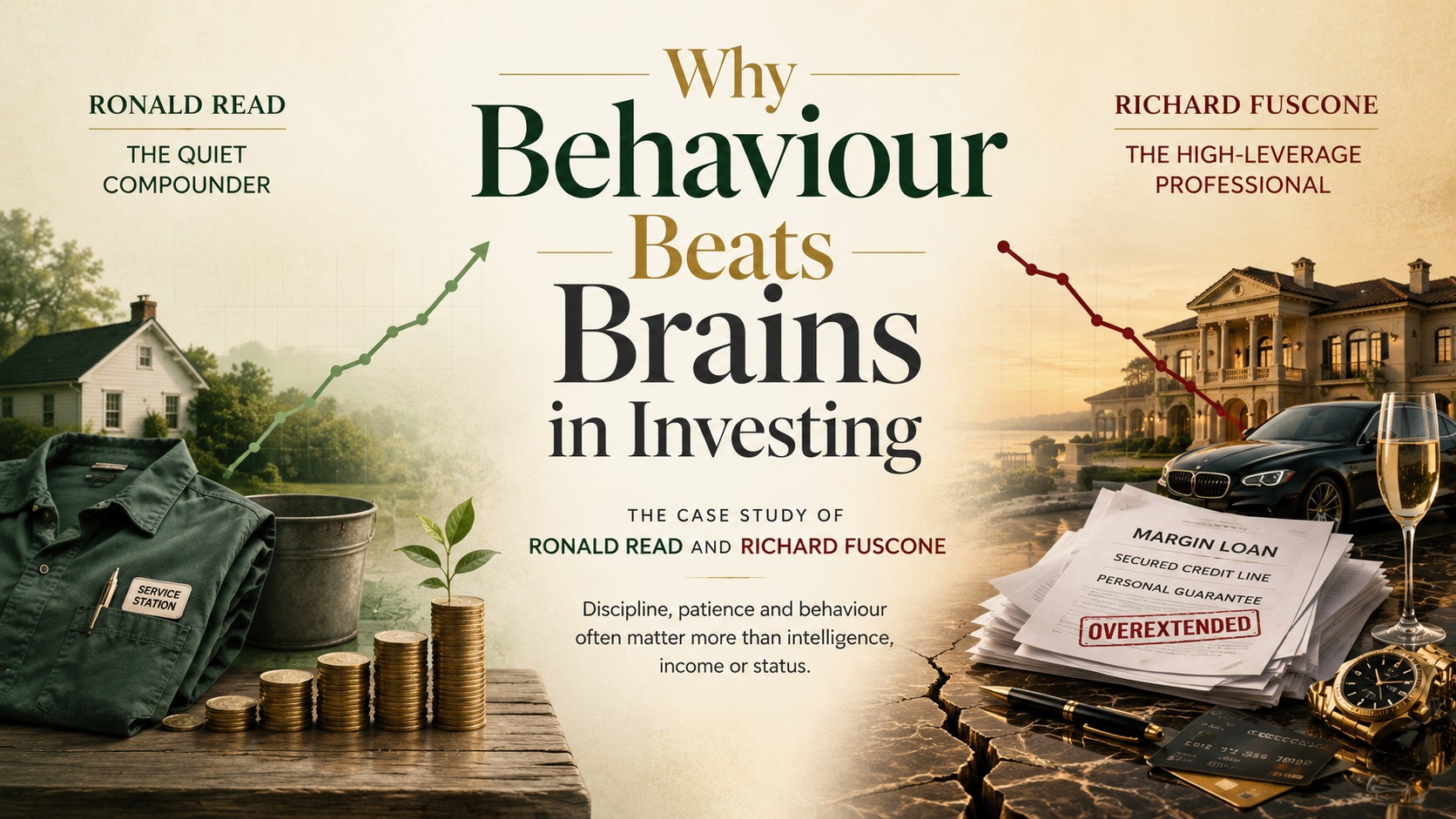
Why Behaviour Beats Brains in Investing: The Case Study of Ronald Read and Richard Fuscone
We are taught from an early age that extraordinary financial success requires extraordinary intelligence. We assume the market’s top performers are quantitative experts with elite degrees, complex models, and an intricate grasp of macroeconomics. The history of finance, however, presents a compelling counter-argument.
In what other field can a person with no formal training, no professional network, and no specialist knowledge consistently outperform a decorated industry expert? You cannot outperform a surgeon at the operating table without a medical qualification. You cannot improve on a structural engineer’s bridge design without an advanced physics background.
Yet in finance, a modest janitor built an ₹67 crore fortune, while a Harvard-educated Merrill Lynch executive filed for bankruptcy. This is the story of Ronald Read and Richard Fuscone—and it contains one of the most important lessons any investor can learn.
How you behave with money is far more important than what you know about it. A good Financial Coach will tell you: technical knowledge alone does not build wealth. Consistent, disciplined behaviour does.
Two Investors. Two Outcomes.
To understand the scale of this divergence, consider the parallel trajectories of two individuals who occupied opposite extremes of the financial spectrum.
Ronald Read: The Quiet Compounder
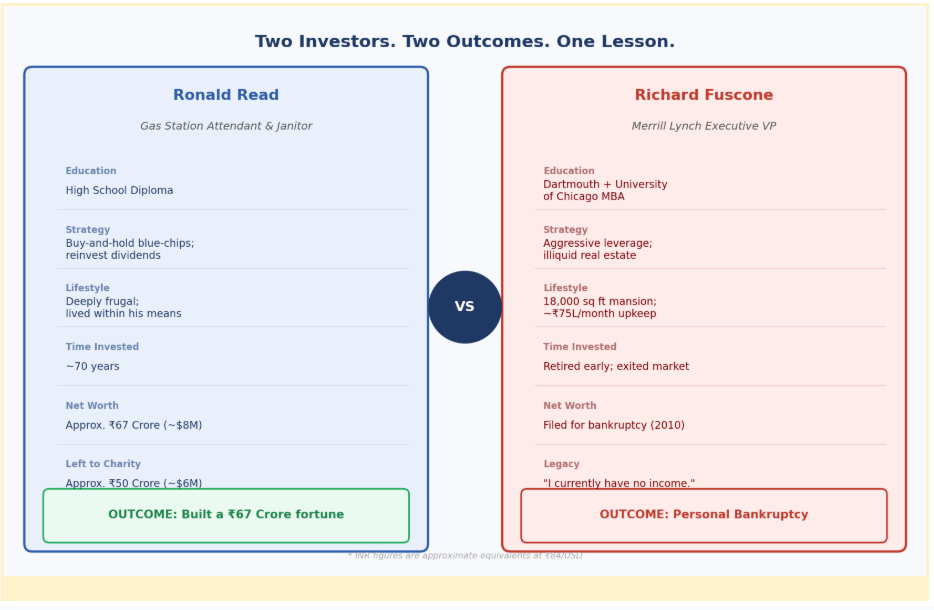
Ronald Read lived an unremarkable life by most measures. For 25 years he repaired cars at a service station in Brattleboro, Vermont, and spent a further 17 years part-time as a janitor at JCPenney. He drove a used car, cut his own firewood, and ate modestly. When he passed away in 2014 at the age of 92, his community discovered he had quietly accumulated a fortune of approximately ₹67 crore (around $8 million).
His method was straightforward. He took a fraction of his modest wages and invested regularly into high-quality, dividend-paying companies—businesses like Procter & Gamble and Johnson & Johnson—and held them for decades. He avoided the trap of fund hopping. He reinvested dividends automatically. He did not panic during market downturns. He simply let compounding run, uninterrupted, for nearly 70 years.
Of his ₹67 crore estate, approximately ₹50 crore was donated to charity.
Richard Fuscone: The High-Leverage Professional
Richard Fuscone’s trajectory looked, for a long time, like a study in professional success. Armed with degrees from Dartmouth and the University of Chicago, he rose to become Executive Vice Chairman of Latin America at Merrill Lynch, was named to prominent ‘40 Under 40’” lists, and retired early to pursue philanthropy.
But financial acumen without behavioural restraint is a precarious combination. Fuscone fell into the trap of Wealth Mirroring—replicating and projecting a premium lifestyle under the assumption that visible spending reflects genuine financial stability. In the mid-2000s, he borrowed heavily to build an 18,471-square-foot mansion in Greenwich, Connecticut, with a monthly maintenance cost exceeding ₹75 lakh. His net worth rested not on growing, liquid assets but on highly leveraged, illiquid holdings.
When the 2008 financial crisis struck, the structure collapsed. Without an emergency fund or defensive provisions, he was forced into exactly the kind of distressed sale that permanently destroys compounding. In 2010, Richard Fuscone filed for personal bankruptcy. His Greenwich estate was sold at foreclosure for a fraction of its value.
His statement to the bankruptcy court: “I currently have no income.”
Why Intelligent People Make Poor Financial Decisions
The divergence between Read and Fuscone reveals a critical truth: financial success is not a technical discipline. It is a behavioural one. A high IQ or an elite qualification does not protect you against impatience, overconfidence, or lifestyle inflation.
Many high-earning professionals confuse income with wealth. They assume that a senior title or a large salary automatically produces financial security. When that belief goes unchallenged, it enables exactly the pattern that destroyed Fuscone: excessive leverage, insufficient reserves, and a portfolio built around appearances rather than assets.
When educated, high-earning individuals fail financially, it is rarely because they misunderstood the mathematics. It is because they allowed emotion to dictate strategy—borrowing at market peaks, liquidating at market lows, and spending beyond their means to maintain an image.
Three Behavioural Patterns That Erode Wealth
1. Lifestyle Inflation Crowds Out Investment Capital
Every rupee directed toward a depreciating lifestyle asset—a financed vehicle, a luxury upgrade, status-driven spending—is a rupee not compounding in your portfolio. Genuine wealth is built quietly through assets that grow over time, not through what others can observe. When ego shapes the monthly budget, lifestyle inflation becomes a direct and ongoing cost to long-term financial security.
2. Forced Sales Permanently Reset the Compounding Clock
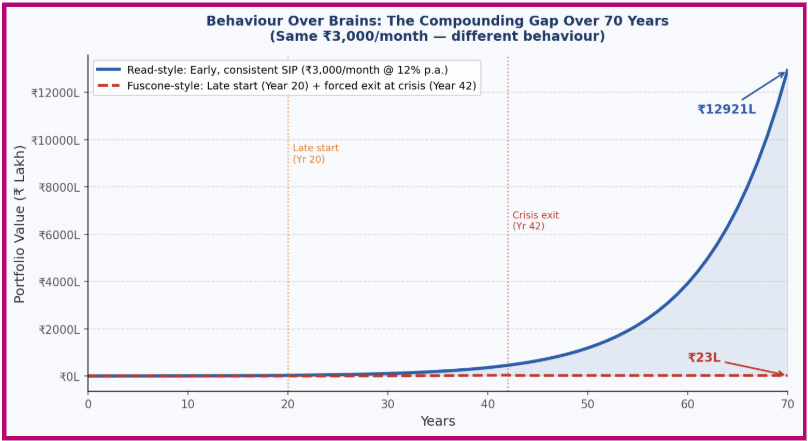
Investing without a financial buffer—an emergency fund covering three to six months of expenses and adequate insurance—leaves the portfolio entirely exposed to personal shocks. When an emergency coincides with a market downturn, the investor is forced to liquidate at the worst possible moment. That capital exits the portfolio permanently, and the compounding trajectory never fully recovers. The chart below illustrates what this means in practice.
Both investors in this illustration start with the same ₹3,000 per month. The Read-style investor begins immediately and stays invested. The Fuscone-style investor starts 20 years later and is forced to exit at the crisis. By Year 70, the gap runs to thousands of lakhs—not because of superior stock selection, but because of one consistent behavioural difference: staying invested without interruption.
3. Constant Monitoring and Fund Hopping Introduce Unnecessary Drag
Attempting to time the market, switching funds in pursuit of recent outperformers, or reacting to short-term volatility introduces exit loads, short-term capital gains taxes, and the kind of decision fatigue that leads to further poor choices. Ronald Read made none of these errors—not because he was financially sophisticated, but because he had the patience to do nothing when doing nothing was the right answer.
Automating Good Behaviour: The Role of SIPs and Managed Funds
Most investors do not aspire to live as frugally as Ronald Read. But most investors do want his results: financial freedom, genuine security, and a portfolio that grows while they focus on their career and family. The good news is that the behavioural traits that made Read wealthy can be built into a system—so they do not depend on daily willpower.
- Discipline through automation: A monthly SIP deploys your investment before the money is available to spend. Consistency is built into the structure, not dependent on your mood or the month’s circumstances.
- Volatility neutralised through rupee cost averaging: When markets fall, your fixed monthly contribution buys more units at lower prices. The need to time the market is removed entirely.
- Active management handled by professionals: Diversified investment structures automatically rebalance internal allocations in response to market conditions, avoiding friction costs and administrative burdens while requiring no ongoing manual intervention.
The Simplest Investing Edge
Long-term wealth is rarely built by the investor who moves fastest or understands the most. It is built by the investor who stays the longest, controls their ego, and allows time to do the heavy lifting.
Ronald Read had no MBA. He had no Bloomberg terminal or research team. He had patience, consistency, and the discipline to leave his investments undisturbed for decades. Those qualities are not reserved for janitors or financial savants—they are available to anyone willing to build them into a system.
If you would like to build that kind of system around your own financial goals, speak with a Financial Coach today.