Why Emergency Funds and Insurance Are Not a Drag on Your Wealth—They Are the Foundation of It
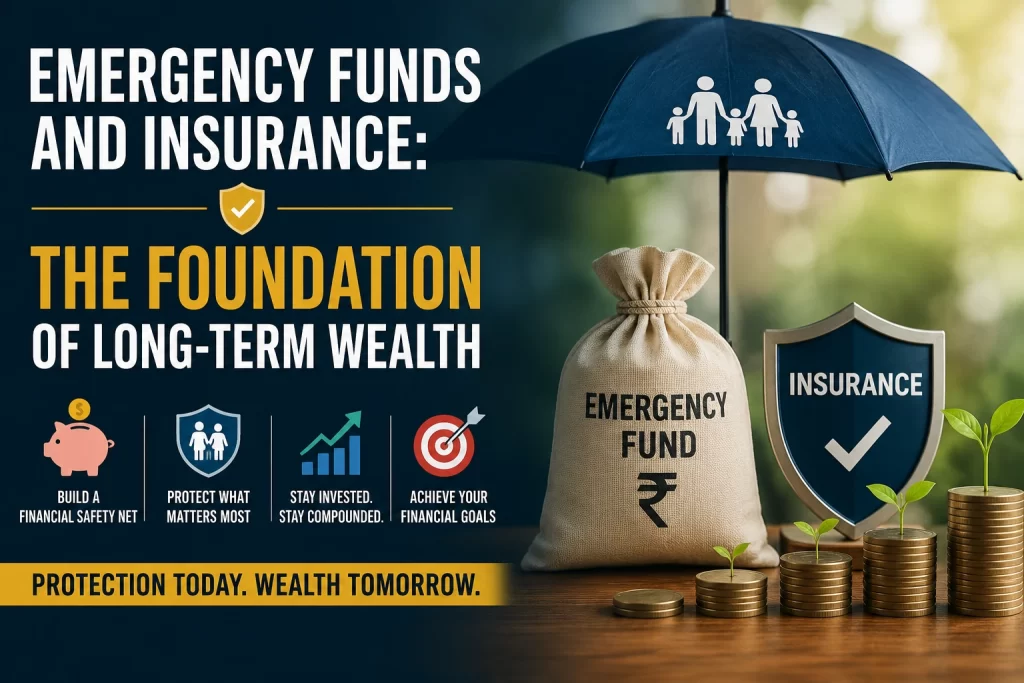
There is a persistent belief among investors—particularly those who are newly confident in the market—that keeping money in a savings account or paying insurance premiums is somehow wasteful. If the money is not working hard, it is not working at all.
This view is understandable, but it carries significant risk. A portfolio built entirely around growth, with no financial safety net, is not an aggressive strategy—it is a fragile one. The moment a personal emergency or market shock arrives, the absence of liquid reserves can force decisions that permanently damage long-term wealth.
A good MFD will tell you: an emergency fund and adequate insurance coverage are not a compromise on your returns. They are what allow you to stay invested long enough to earn them.
What Happens When There Is No Safety Net
The danger of investing without a financial buffer becomes most apparent during periods of stress. The sequence is predictable:
- The Emergency: A sudden medical expense, job loss, or urgent personal liability arises—often at the same time as a broader market downturn.
- The Forced Sale: Without liquid reserves or insurance coverage, the investor must sell equity holdings or mutual fund units at a loss to meet the immediate need.
- The Compounding Reset: Those units, sold at the worst possible moment, are no longer in the portfolio to recover and grow when the market rebounds. The long-term compounding trajectory is interrupted—and that lost time cannot be recovered.
The chart below illustrates this scenario clearly.
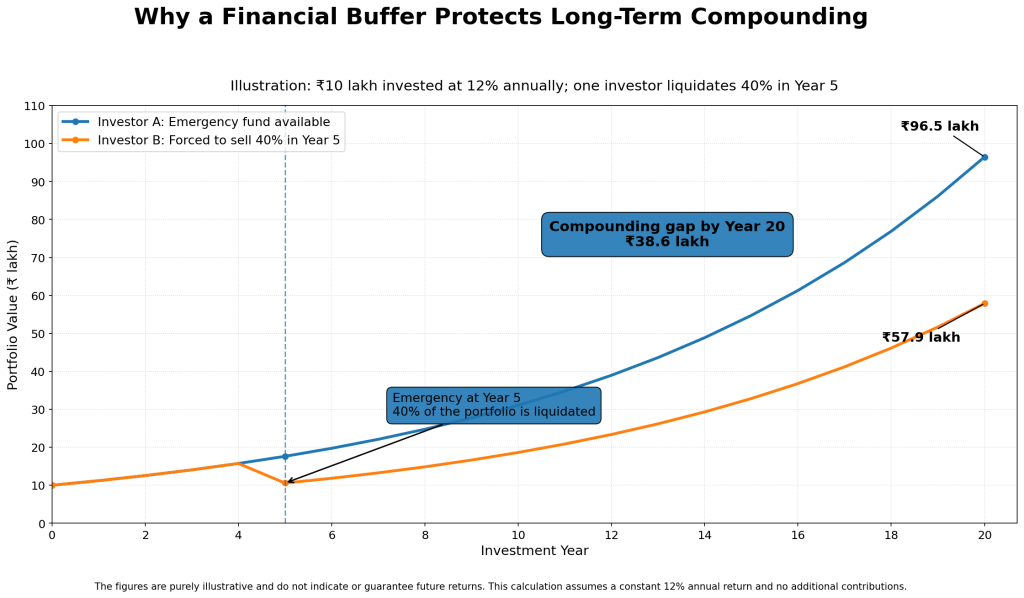
The figures used above are purely illustrative and do not indicate or guarantee future returns.
Both investors start with ₹10 lakh. Both earn 12% annually. The only difference: one has an emergency fund and stays fully invested through the crash at Year 5. The other does not, and is forced to liquidate 40% of their portfolio at the bottom. By Year 20, the gap in portfolio value exceeds ₹47 lakh—not because of better stock picks, but because of one structural decision made at the outset.
Three Reasons Defensive Provisions Strengthen Your Portfolio
1. They Protect You From Your Own Reactions
The greatest threat to most long-term investment portfolios is not a market crash—it is the investor’s response to one. When your immediate financial needs are covered by a separate cash reserve, a fall in your portfolio value becomes far less alarming. You are not dependent on that money today, which means you can afford to wait for a recovery. This separation between your survival finances and your investment portfolio is one of the most powerful behavioural tools available to any investor.
2. They Eliminate Forced Decisions at the Worst Time
Insurance and emergency funds do not just protect your finances—they protect your investment strategy. Without them, a personal crisis forces you to make a financial decision under pressure, at a time when market conditions are often unfavourable. With them, risk is absorbed by a structure you built in advance, leaving your portfolio untouched and your compounding engine running.
3. They Make Long-Term Investing Sustainable
High earnings and financial intelligence do not automatically prevent financial difficulty. What protects investors across income levels is the discipline to systemise their security—to treat emergency reserves and insurance premiums as essential, non-negotiable components of a financial roadmap, not as optional extras that can be deferred until later.
Building a Portfolio That Can Weather Any Condition
Establish Your Safety Net Before Increasing Market Exposure
Before increasing your SIP contributions or taking on greater market exposure, ensure you have a dedicated emergency fund covering three to six months of living expenses, held in a liquid instrument such as a savings account or liquid mutual fund. This is not money sitting idle—it is the foundation that makes your investment strategy viable under real-world conditions.
Automate Both Growth and Protection
Just as a Systematic Investment Plan (SIP) automates your investment contributions, your insurance premiums and emergency fund top-ups should be treated the same way—set up as automatic, recurring commitments that require no monthly decision. When financial discipline is built into the structure rather than dependent on willpower, it holds far more reliably.
Keep Your Protective Provisions Proportional to Your Lifestyle
As your income and lifestyle grow, your emergency fund and insurance coverage should grow with them. A safety net calibrated to an earlier, simpler life will not adequately protect a more complex financial situation. Reviewing these provisions regularly—particularly after major life changes such as a salary increase, a new dependent, or a property purchase—ensures your protection keeps pace with your progress.
How a MFD Helps You Get This Right
Knowing that emergency funds and insurance matter is one thing. Calculating the right amounts, choosing the right products, and integrating them into a coherent financial roadmap is another.
A MFD helps you build financial resilience by:
- Assessing how much you genuinely need in emergency reserves based on your income, obligations, and risk profile
- Identifying the right insurance coverage—health, life, income protection—and ensuring there are no critical gaps
- Structuring your overall financial roadmap so that protection and growth work together, not in competition
- Reviewing your safety net as your circumstances evolve, so it remains adequate at every stage
The goal is not to minimise the money allocated to protection. It is to ensure that the money allocated to growth can do its job—without being interrupted.
Invest with Confidence, Not Just Ambition
The investors who build lasting wealth are not necessarily the ones who take the most risk. They are the ones who manage risk intelligently—staying invested through difficult periods because they have structured their finances to withstand them.
An emergency fund and the right insurance coverage do not slow down your wealth-building. They make it possible to continue building, regardless of what happens along the way.
If you would like to review your financial safety net and ensure your investment strategy is built on solid foundations, speak with a MFD today.
DISCLAIMER: Mutual Fund investments are subject to market risks. Read all scheme related documents carefully.